For many modern American Christians, Epiphany is perhaps the least known of all of the “red letter” days on the church calendar. The Epiphany season holds space on the calendar between the end of the Christmas season and the beginning of the Lent Season. As the name suggests, Epiphany celebrates and honors the ways in which Jesus Christ was revealed to the world as the Son of God, from the visit of the Magi following His birth, to His baptism in the Jordan River, to His glorification on the Mount of Transfiguration.
Epiphany begins on January 6, which is known as Feast of the Epiphany. In some countries, January 6 is called “Three Kings Day” and is marked by greater and grander celebrations and gift-giving than Christmas Day. The day before Epiphany, January 5, is sometimes called Epiphany Eve or the Twelfth Night, as in William Shakespeare’s play by the same name. (Yes, Virginia, there really are 12 days of Christmas!)
In some traditions, the conclusion of the Epiphany season coincides with Mardi Gras, which begins on the Saturday night before Transfiguration Sunday and ends on Shrove Tuesday (a/k/a “Fat” Tuesday), which is always the day before Ash Wednesday, which marks the first day of Lent.

Come to your Senses
Some of the ways that people celebrate Epiphany around the world may seem surprising, especially when compared to the way most Americans celebrate Christmas. With the notable exception of frenzied shopping for presents, most American Christmas traditions occur inside the home or in church buildings and tend to emphasize comfort. The elements of the Christmas season almost seem designed to invoke a certain soothing or pacifying of the senses (i.e., candlelight services, cozy sweaters, hot chocolate, egg nog, and dark shades of green, red, and burgundy).
In contrast, Epiphany celebrations (i.e., jumping into icy water, going to noisy parties, and decorating with bright shades of green, yellow, and purple) seem designed to invigorate and awaken the senses. Epiphany celebrations also tend to be held in public spaces as if to reflect and perhaps replicate the original ways in which Jesus Christ was revealed and proclaimed to be the Messiah. The whole season seems to shout out to the world: “Wake Up!”
I am personally struck by the way that our physical senses are involved not only in Epiphany celebrations around the world but also in the Epiphany stories from the Bible. This article explores some of the interesting roles that our physical senses play during the Epiphany season and also recommends some new ways that modern American Christians can appreciate and celebrate Epiphany as an opportunity to develop greater sensory awareness.
Making Sense of the Season
Especially in Western Christianity, Epiphany tends to emphasize the wise men who came to see the infant child Jesus and brought Him gifts of gold, frankincense, and myrrh. While the Bible does not tell us the number or the names of these wise men, certain traditions have identified three:
Caspar, who was dressed in green and brought the gift of frankincense;
Balthazar, who was dressed in purple and brought the gift of myrrh; and
Melchior, who was dressed in gold and brought the gift of gold.
A tradition known as “chalking of the doors” is one of the more ancient ways that Christians in Western Europe have celebrated the visit of the Magi during Epiphany. In this practice, on Epiphany Day, Christians use chalk to inscribe a formula on the doors of their homes and churches. The formula includes symbols that represent Jesus Christ, the Three Kings, and the current century and year in which the season occurs. In 2018, for example, the following symbols were used: 20 + C + M + B + 18, as shown in the image below:
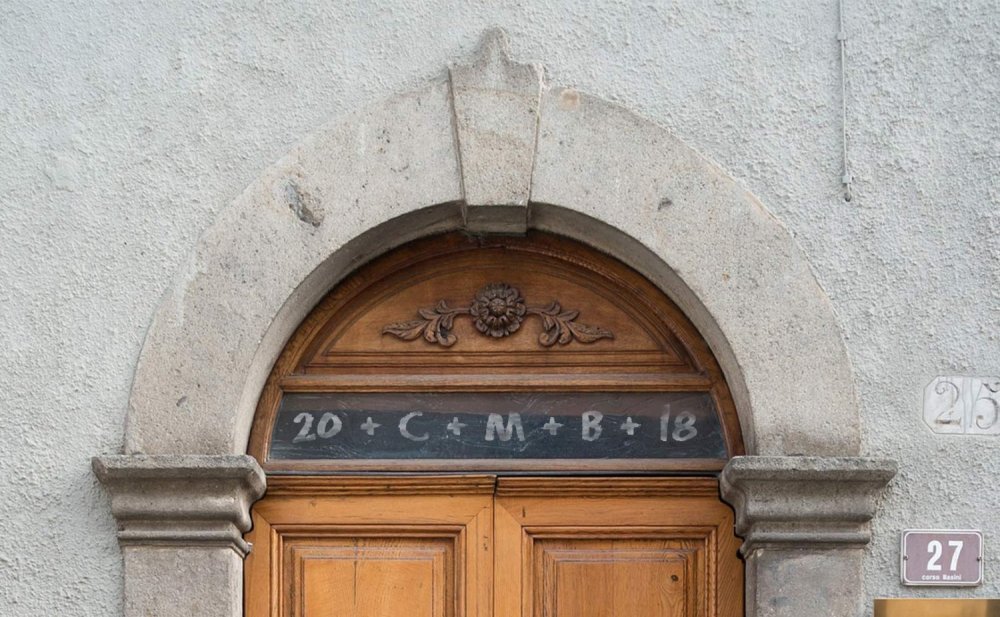
The initials C, M, and B, not only represent the names of Caspar, Melchior, and Balthazar, but also the Latin phrase “Christus Mansionem Benedicat” which means “Christ bless this home!” The plus sign in the equation represents the Cross of Christ. By including the year of the current Epiphany season, this equation not only serves to dedicate the home and its inhabitants to God for another year but also reminds residents and visitors of their place in history. The equation also signifies the hope that those in the world will find Jesus Christ when they visit the home just as the wise men found Jesus Christ in Bethlehem. Placing this equation on the outside of the door also signifies that the Epiphany season is a public proclamation and celebration of the Good News that Jesus Christ has been revealed to the world as the Son of God.
In contrast to the fairly subtle practice of chalking, many cultures celebrate Three Kings Day with noisy parades that truly dazzle the senses with spectacular sights and sounds. Many Spanish-speaking communities, for example, have a parade on January 6, known in Spanish as Dia de los Tres Reyes. Spanish-speaking Christians also celebrate Dia de los Tres Reyes with a Spanish version of the King Cake (discussed below) called a Rosca de Reyes. In Mexico City, the Dia de los Tres Reyes festival features a Rosca de Reyes that is one mile long. Imagine the physical senses that might be aroused at that party!
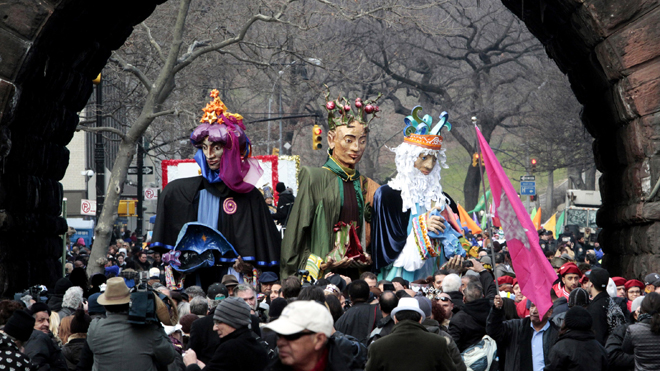
The annual Three Kings Day Parade in Spanish Harlem, New York.

Mardi Gras marks the end of Epiphany, with perhaps the most flamboyant and extravagant celebrations anywhere in the world. It is both ironic and perhaps symbolic of the purpose of the Epiphany season that most people who celebrate Mardi Gras might not know . . . or might be too drunk to care . . . that they are actually participating in an ancient Christian holiday. Mardi Gras celebrations notoriously involve parades, loud music, excessive eating and drinking, and gaudy costumes and decorations with green, purple, and gold. In addition to the world-famous Mardi Gras festival in New Orleans every year, similar events take place in many cities around the country. For example, the pictures below are from the annual Mardi Gras event in Asheville, North Carolina.
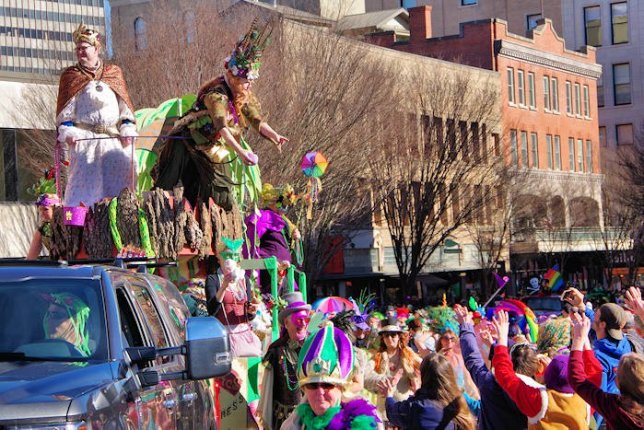
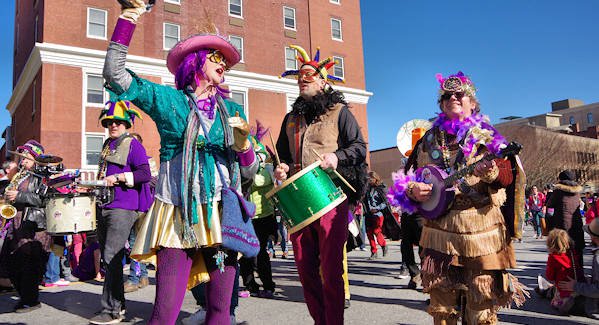
In addition to the dazzling sights and sounds of parties and parades, the Epiphany season also features its own special dessert to excite your sense of taste, called a King Cake (known in Spanish as a Rosca de Reyes). The King Cake is decorated with green, purple, and gold and is stuffed with a tiny baby, as shown in the picture below. The person who finds the baby may be blessed with a special gift or may be asked to throw a party the following year.

While Christians in American and Western European cultures tend to emphasize the visit of the wise men during Epiphany, Eastern Orthodox Christians tend to highlight the baptism of Jesus Christ during the Epiphany season. For example, Eastern Orthodox Christians in Turkey, Greece, Bulgaria, and other parts of the world, celebrate Epiphany in news-making athletic competitions where a priest throws a wooden cross into the water and hundreds of men from the community dive in to see who can retrieve it. Men in Russia celebrate Epiphany by lining up to walk through frigid waters where iced-over rivers and lakes have been carved out to create a baptismal fount in the shape of a cross. These activities, some examples of which are shown in the pictures below, make news all over the world each year with perhaps the most awesome public display of masculinity in all of Christendom. It is truly impressive that these communities celebrate the Feast of the Epiphany with a community-wide whole-body experience. Talk about waking the senses!


Making Sense of the Stories
We can also grow in our appreciation of the role that our physical senses play in our spirituality when we reflect upon the biblical stories that are remembered during Epiphany.
The Bible tells us that the wise men found the Baby Jesus by following the Star of Bethlehem. This star, which must have shone brighter in the night sky than all the others, reminds us of the gift of sight. It was only through their sense of sight that the wise men were able to observe the star and discern the message it was sending to them. Following a star at night, however, is very different than walking in the sunlight during the day. It was only in the darkness that the wise men were able to see the star. The Star of Bethlehem, therefore, reminds Christians that we walk by faith and not by sight. (2 Corinthians 5:7) The Star of Bethlehem also reminds us that while we we are living in this world awaiting Christ’s return, we are to live our lives as stars shining in the darkness. (Philippians 2:15) One could even say that the Body of Christ today serves the same purpose as the Star of Bethlehem: to shine a light in the darkness that will show people where to find Jesus.
One of the other surprising gifts of darkness is that our other senses can often grow in strength as our ability to rely on the sense of sight diminishes. The story of the Magi also reminds us of some of the other senses, too.
For example, the gifts of frankincense and myrrh remind us of the sense of smell. Frankincense was an herb that was burned to create a heavenly aroma during worship. Myrrh, on the other hand, was used during burial rites to sweeten the smell of rotting corpses. Combined together, those fragrances would have had a potently sweet smell indeed. Experts in the field of psychology and neurology say that our sense of smell can connect us with our emotional memories more powerfully than any other. In a similar sense, it is fascinating to think that today anytime we smell the aroma of frankincense and myrrh we are experiencing the same sensations that Baby Jesus experienced thousands of years ago after He was born.
The gift of gold, on the other hand, can remind us of the senses of touch and taste. While the senses of sight, sound, and smell can seem somewhat intangible, the acts of touching and tasting are almost always used in our interactions with tangible things. In fact, the very definition of tangible means something that can be touched. When Jesus appeared to His disciples after His resurrection, he ate some food and told them to touch the scars in His hands and side to prove that what they were seeing and hearing was real. (Luke 24:39-43) In the same way, the gift of gold that was offered to Mary and Joseph on behalf of Baby Jesus was a tangible gift that could be touched and held in their hands and used in a practical way to meet the needs of their family while they evaded the evil plot of King Herod.
The gift of gold also relates, believe it or not, to the sense of taste. Some say that the easiest way to tell that a substance contains real gold is to put it on your tongue and taste it, like Yukon Cornelius did in the clay animation movie Rudolph the Red-Nosed Reindeer.

The sense of hearing, meanwhile, is centrally involved in the other stories that are celebrated during Epiphany. When Jesus was baptized in the Jordan River by John the Baptist, those present heard a voice from heaven say, “This is my Beloved Son, in whom I am well pleased.” (Matthew 3:16-17) Similarly, on the Mount of Transfiguration, Peter, James and John heard a voice say to them, “This is my Beloved Son in whom I am well pleased. Listen to Him!” (Mark 9:7) For Christians, our sense of hearing is preeminent among all the others, as the Apostle Paul said, “So then faith comes by hearing and hearing by the Word of God.” (Romans 10:17)
Epiphany indeed presents itself as a perfect opportunity to celebrate and appreciate our senses of sight, sound, smell, touch, and taste. The festivities around Epiphany give us many opportunities to both excite and employ these senses. The stories around Epiphany also remind us that it is God who both created and exploited these physical senses so that we would be able to see, hear, touch, taste, and smell the ways in which God reveals Himself to us, most importantly in the person and the message of His Son, Jesus Christ!

 Pilgrim Age