Calendars and Cultures Collide
For the first time since 1945, Valentine’s Day in 2018 will fall on Ash Wednesday. Ash Wednesday is the first day of Lent, which is observed by over 30% of evangelical Christians and over 60% of Catholics, according to Christianity Today. Many Christians observe Ash Wednesday by attending liturgical communion services, having a cross marked with ashes on their foreheads, fasting or abstaining from sensual pleasures, and taking on a posture of contrition for one’s sins.
In contrast with the reverent discipline observed by some Christians on Ash Wednesday, Valentine’s Day is often driven by a desire to spoil ourselves and our loved ones. The National Retail Federation estimates that 55% of Americans will celebrate the holiday this year and spend $19.6 billion, up from $18.2 billion last year. The major categories of expenditures include candy, flowers, greeting cards, jewelry, clothing, or nights out on the town.
This convergence could create more than just scheduling conflicts. According to the National Retail Federation, candy is the most popular gift that people plan to give this year for Valentine’s Day. That heart-shaped box of chocolates should come with a warning label in 2018, however, because chocolate (along with all sweets in general) is consistently one of the most popular items that people give up for Lent, according to multiple sources who track that information from year to year. (i.e., Christianity Today, The Independent, The Washington Post). Men beware! Don’t be that guy!

Some may wonder how best to resolve this impending clash of calendars and cultures. The leaders of the Catholic Church announced this year that Ash Wednesday trumps St. Valentine’s Day, and recommended that lovers celebrate their romantic affections and intentions on Mardi Gras, the day before Ash Wednesday, which is customarily set aside as the final day for indulging before Lent begins. Other denominations, such as the United Methodist Church, have suggested ways to reconcile the two days by emphasizing that marking the symbol of the cross on a person’s forehead reminds us of the greatest possible act of love, that of Christ laying down His life for mankind.
This year, February 14 indeed gives Christians a unique opportunity to not only appreciate the romantic and erotic love that we celebrate on Valentine’s Day but also the agape love that we celebrate on Ash Wednesday. What many Christians may not know is that the real man known as St. Valentine also provides a powerful example of true love, that of a man laying down his life for Christ. The life of St. Valentine can teach Christian men not only how to be a good lover but also how to be a strong warrior!
The Man – The Martyr – The Legend
Despite the prominence of the holiday bearing his name, very little is known about the real St. Valentine. The date of February 14 was first set aside as the “Feast of St. Valentine” by Pope Gelasius I in the year 496 A.D. In venerating the saint, Pope Gelasius did not recite any specific information about him, except to include him among all those “whose names are justly reverenced among men, but whose acts are known only to God.” Some historians suggest that February 14 was chosen based on records showing that St. Valentine was martyred on that date by the Roman Empire. Others suggest that February 14 was chosen to create a Christian alternative to the pagan festival of Lupercalia that also occurred in mid-February during ancient Roman times.

According to The Catholic Encyclopedia, several men named Valentinus were martyred by the Roman Empire during the late third century, A.D. One of those men is said to have been a priest in Rome while the other is said to have been the Bishop of Interamna, which is modern day Terni in central Italy. The Orthodox Church in America also recognizes two different men with the same name: Martyr Valentinus, the Presbyter of Rome, is celebrated on July 6, and Hieromartyr Valentine, the Bishop of Interamna, is celebrated on July 30. The Roman Martyrology, the Catholic Church’s official list of saints, only recognizes one St. Valentine who was martyred on February 14 on the Via Flaminia on the outskirts of Rome. Due to the lack of verifiable historical information, the Catholic Church removed the celebration of St. Valentine’s Day on February 14 from its General Calendar, while still keeping St. Valentine on its official list of recognized saints and martyrs. Historical accounts place his martyrdom sometime between 269 and 273, A.D.
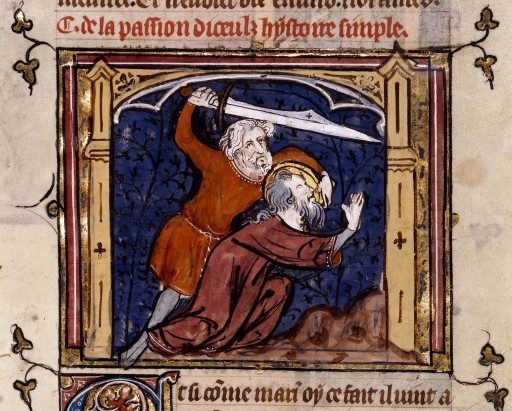
Even though nothing was known about St. Valentine at the time that he was canonized by Pope Gelasius almost 200 years after his death, legends developed in later years about the circumstances surrounding his martyrdom. One legend about St. Valentine states that he illegally performed marriages for young men who were either soldiers or eligible to be soldiers in the Roman army at a time when the Roman government saw marriage as an impediment to military service.
St. Valentine the Warrior

Around the year 1260 A.D., Jacobus de Varagine, the archbishop of Genoa, included the following description of St. Valentine in his Legenda Aurea, a widely-read compilation of stories about the lives of saints and martyrs:
SAINT VALENTINE – February 14
from The Golden Legend1Valentine comes from valorem tenens, one who perseveres in holiness. Or it comes from valens tiro, a strong warrior, one who fights for Christ. But a warrior is strong only when he remains unconquered, bravely attacks, defends himself valiantly, victory. And so Valentine was never conquered, for he never fled martyrdom; he attacked the idols in exterminating them; he defended, the faith in that he strengthened it; he carried off victory in that he suffered.
1. From: The Golden Legend of Jacobus de Voragine, trans. and adapted by Ryan, Granger and Helmut Ripperger. (Arno Press: Longmans, Green & Co) 1941. pp. 165-166.
In 1493, a German, Hartmann Schedel, compiled a history of the human race including biblical and post-biblical accounts of major events. Known in English as the Nuremburg Chronicles, the text included a description of the martyrdom of St. Valentine as occurring sometime between 269 and 273 A.D. The text stated that Valentine, a Roman priest, was arrested and imprisoned for marrying Christian couples. When Valentine attempted to convert the Emperor Claudius to Christianity while he was imprisoned, the Emperor condemned him to death and he was beheaded outside the Flaminian Gate in Rome.
Though St. Valentine today is thought of as the patron saint of lovers, Christians in the middle ages remembered him first and foremost as a “warrior” who stood firm in his convictions and proclaimed the Gospel of Christ against the fear of death. Even in the legends stating that he promoted marriages for young soldiers against the orders of the Roman Empire, Valentine provides an example of promoting a biblical Judeo-Christian view of marriage to the culture of his time. Though the government viewed marriage and family as an impediment to military service, the Bible tells us that men should fight for their wives, their families, and their communities. (Nehemiah 4:14)
St. Valentine the Lover

In the later years of the Middle Ages, St. Valentine’s Day came to be known as a special day for lovers to celebrate their affection, perhaps based on the legendary accounts of St. Valentine’s bravery in supporting marriage and perhaps based on medieval fables that held mid-February as the mating season for birds.
The first published example of this association appears in Geoffrey Chaucer’s Parliament of Foules, which Chaucer wrote in 1382 to celebrate the marriage of young King Richard II to Queen Anne of Bohemia. The poem describes a gathering of birds on Valentine’s Day when Mother Nature assigns each of them a mate:
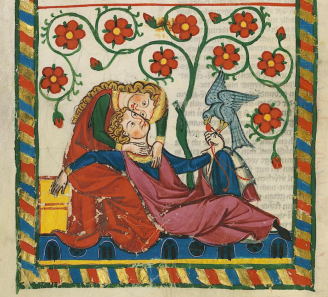
“There sat a queen who was more lovely by far than any other creature, just as the summer sun outshines the stars. This noble goddess Nature sat enthroned in a pavilion she had wrought of branches upon a flowered hill atop a meadow. And there was not any bird born of love that was not ready in her presence to hear her and receive her judgment. For this was Saint Valentine’s Day, when all the birds of every kind that men can imagine come to choose their mates.”
Not long after that, in the year 1410 A.D., the first recorded Valentine poem was written by Charles, Duke of Orleans, to his wife, Bonne of Armagnac, while he was imprisoned in the Tower of London after his defeat in the Battle of Agincourt. Translated into English, the poem, titled A Farewell to Love, said:

My very gentle Valentine,
Since for me you were born too soon, And I for you was born too late.
God forgives him who has estranged
Me from you for the whole year.
I am already sick of love,
My very gentle Valentine.Well might I have suspected
That such a destiny,
Thus would have happened this day,
How much that Love would have commanded.
I am already sick of love,
My very gentle Valentine.
By the time of Queen Victoria, Valentine’s Day had ascended in popularity such that at least half of the people living in England sent hand-written Valentine’s Day cards to their loved ones to celebrate that day. In 1861, Richard Cadbury created heart-shaped boxes to promote his chocolate confections as the perfect gift on Valentine’s Day.

In the United States, the famous Sweethearts candies were invented by the New England Confectionary Company (NECCO), which began business in 1847 in Massachusetts.

Hallmark first started printing Valentine’s Day cards in 1915.


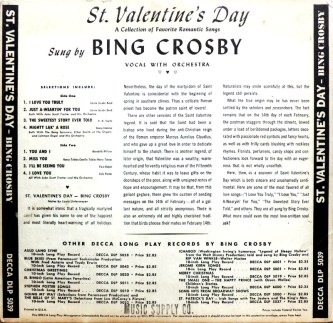
In 1949, Bing Crosby released his compilation album of popular love songs, aptly titled “St. Valentine’s Day” that also included the artist’s take on the history of St. Valentine.

 Pilgrim Age