Easter is a big deal for the church. Practically speaking, more people attend worship services on Easter Sunday around the world than any other day of the year. As a result, modern church organizations make huge investments of money, time, and human energy into planning and preparing for the Big Day, hoping to make the most of the opportunity to reach searching souls with the Good News of new life in Jesus Christ.
Theologically speaking, of course, Easter is important to the church because without Easter there would not be a church. Without Easter, there would be nothing good about Good Friday. Without Easter, there would be no Christ in Christmas. Apart from Easter, the other dates on the church calendar would have no meaning at all.
For many, unfortunately, Easter may be the only day that they attend church in a given year. That is truly a pity. For just as the other days on the church calendar have no meaning apart from Easter, so too Easter cannot be fully understood and appreciated in a vacuum.
The Holy Week
Perhaps for that reason, for thousands of years, Christians have set aside the days leading up to Easter as a special season, called Holy Week or Passion Week, the latter referencing the suffering of Jesus Christ during his final days. Modern Christians seem to have strayed from the practice of observing the different and distinct days of Holy Week. In fact, even some of the churches that do celebrate Holy Week have collapsed it into the three days, consisting of Maundy Thursday, Good Friday, and Black Saturday, prior to Easter. Here is a summary of all seven days of the traditional Holy Week, with a brief description of the biblical events that are recalled on those days.
Palm Sunday – On the Sunday before Easter Sunday (Dia de Resurrecion in Spanish), Christians celebrate the triumphal entry of Jesus into the city of Jerusalem while His followers waved palm fronds and sang and shouted praises to God. Some churches celebrate Palm Sunday by having parishioners wave palm fronds and sing while marching in a procession around the church premises and then entering the church sanctuary.
Holy Monday/Temple Monday – On the Monday of Holy Week, Christians remember Jesus clearing the temple in Jerusalem and also cursing the fruitless fig tree.
Holy Tuesday/Olivet Tuesday – On the Tuesday of Holy Week, Christians remember the many parables and prophecies that Jesus taught his disciples on the Mount of Olives, also known as the Olivet Discourse.
Holy Wednesday/Spy Wednesday – On the Wednesday of Holy Week, Christians remember the time Jesus spent with his friends in their home in Bethany, when the woman anointed Jesus’ feet with precious perfume. This night is also sometimes called “Spy Wednesday” because it is believed that Satan entered Judas Iscariot after this event. All of the Gospels record that all of the disciples objected to the woman wasting her perfume in such a way but the Gospel of John states that Judas objected the most strenuously and opened himself up to satanic influence because he was using the disciples’ treasury for his own benefit.
Maundy Thursday – On the Thursday of Holy Week, Christians remember the special time that Jesus spent with His disciples in the upper room, where Jesus shared a meal with them, instituted the new covenant of the Lord’s Supper, washed their feet, and told them to prepare themselves for the events that were about to transpire. Many Christians celebrate this night, which coincides with the Jewish celebration of the Seder for Passover, by having dinner together followed by communion.
Good Friday – On the Friday of Holy Week, Christians remember the crucifixion of Jesus Christ outside of Jerusalem. Many Christians celebrate this day by fasting and by observing the Stations of the Cross.
Black Saturday – On the Saturday of Holy Week, Christians remember the time in which Jesus lay in the tomb. Some Christians honor this day by fasting and by wearing dark clothing to honor the grief and despair experienced by His family and friends following His death.
The Holy Weak
On Easter Sunday, Jesus proved that He was God by being raised up from the dead. On the preceding seven days, however, Jesus proved that He was a man. The Apostle Paul later wrote that God said to him, “My strength is made perfect in weakness!” It was Christ’s willingness to embrace the weakness of His humanity during Holy Week that made it possible for God to show His strength on that first Easter Sunday!
While researching and writing on this subject, I am personally impressed that during the days leading up to His death, Jesus showed us the complete content of His character. It is only because of His own righteousness that He was able to be made an offering for sin for mankind. “He who knew no sin became sinful man so that we could become the righteousness of God.” (Second Corinthians 5:21) The Bible also tells us, though, that sin is not only doing the wrong thing but also failing to do the right thing. (James 4:17) The events of Holy Week show us that Jesus was Holy not only for the things He did not do but for the things that He did do.
In December, I blogged about the four masculine archetypes of the Warrior, the Lover, the King, and the Sage. In that blog, I explained how the biblical characters that are honored during the season of Advent, the Old Testament Prophets, Joseph, Mary, and the Shepherds, exemplify all four of those archetypes. In that blog, I also referred to The Crucible Project, a men’s organization that uses the four masculine archetypes as a tool for the development of Christian character and leadership. The table attached as a link below provides a useful summary of how men can integrate and incorporate the four masculine archetypes into their own personal and spiritual growth as a man.
According to the accounts given in scripture, each of the first four days of Holy Week seem to correspond to one of the four masculine archetypes. In His last days on earth, Jesus not only showed us how to be a righteous man, He also showed us how to be a real man!
Palm Sunday: Jesus, the King
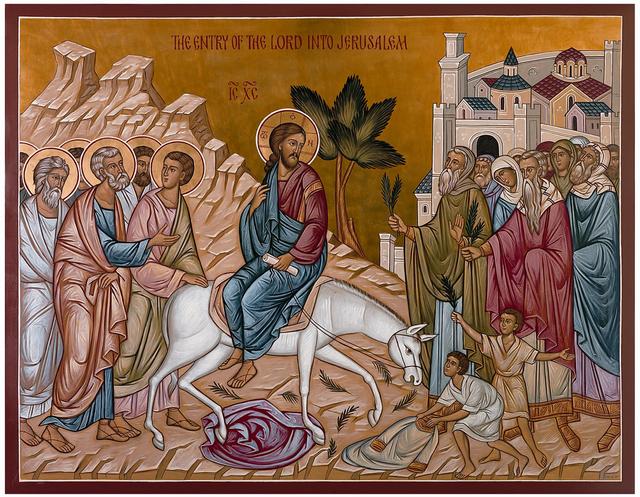
The King archetype is exemplified by men who value authority and prosperity. The King expresses himself by blessing others and by casting vision. The key emotion associated with the King archetype is joy. The triumphal entry of Jesus into Jerusalem on that very first Palm Sunday captures the essence of what it means to be a King. By entering Jerusalem on a donkey, Jesus was declaring Himself to be the long-promised Messiah and the rightful and righteous ruler of Israel, even though the time for the fullness of His Kingdom had not yet come. The people who welcomed Jesus by waving palm fronds also acknowledged His Kingship, shouting Hosanna in the Highest! In Jewish traditions, the fronds of the date palm represented peace, prosperity, and victory and the exuberance of the people truly captured the emotion of joy associated with the King archetype. Jesus Himself was also filled with joy on that occasion, even though Jesus had already told His disciples about the traumatic events that awaited them in Jerusalem. On Palm Sunday, men can honor and remember Jesus as their King by acknowledging that all authority is given by God, leading with an attitude of humility, and learning to embrace the joy of life even amidst dark and despairing times.
Monday: Jesus, the Warrior
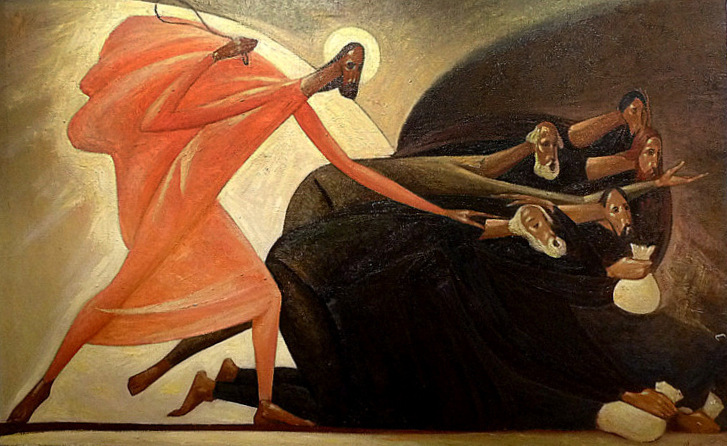
The Warrior archetype if exemplified by men who value clarity and integrity. The Warrior expresses himself by setting boundaries and serving others. The key emotion associated with the Warrior archetype is anger. The clearing of the temple, in which Jesus turned over the tables of the money changers and the vendors, shows us that Jesus knew how to use His anger as a source of physical and spiritual power. Through this act, Jesus was stressing the importance of both clarity and integrity. The money changers were creating a distraction from the true purpose of the temple as a place of worship and were also exploiting those who were poor or who had traveled from foreign lands. His anger, though, while being righteous was not self-righteous. Rather, His anger was intended to serve others and re-establish the temple as a house of prayer for all peoples. On Temple Monday, men can honor and remember Jesus as their Warrior by speaking out against corruption and taking strong positions in defense of those who cannot defend themselves.
Tuesday: Jesus, the Sage

The Sage archetype is exemplified by men who value simplicity and spirituality. The Sage expresses himself by seeking wisdom and truth and teaching others. The key emotion associated with the Sage is fear. The day after He cleared the temple, the scriptures state that Jesus spent part of the day with His disciples within the city of Jerusalem and then spent the rest of the day with them on the Mount of Olives, which is located on the east side of Jerusalem across from the Kidron Valley. He spoke to them in many parables and He also prophesied to them about the end times. Jesus showed the key emotion of fear associated with the Sage in these teachings because He sought to warn His disciples about the dark times that awaited the Jewish people, both in the near future and the distant future. The importance that Jesus placed upon His role as the Sage on that day is illustrated by the amount of text devoted to that day in the scriptures. In the Gospel of Matthew, for example, the triumphal entry is described in eleven verses (Matthew 21:1-11) and the clearing of the temple is described in five verses (Matthew 21:12-16). The parables and prophecies that He taught to His disciples after those events, however, extend across five chapters of text (Matthew 21:17 – 26:2). On Olivet Tuesday, men can honor and remember Jesus as their Sage by studying the scriptures and seeking God’s wisdom in planning for the future and investing in the people that God has placed under their spiritual care.
Wednesday: Jesus, the Lover

The Lover archetype is exemplified by men who value sensuality and sexuality. The Lover expresses himself by creating and/or appreciating beauty and connecting with others. The key emotion associated with the Lover is sadness. Jesus revealed the power and energy that He possessed as a Lover when the woman broke the alabastar jar of expensive perfume and poured it on His head. Jesus showed that in order to be a true Lover, a man must not only be able to give love but must also be able to receive love. Jesus received the woman’s gift as an act of love and mercy and rather than viewing the woman’s gift as a wasteful act, He was able to appreciate the beautiful and symbolic act that the gift represented. The next day, in the Upper Room, Jesus again showed His disciples how to be a Lover when He undressed Himself, wrapped Himself in a towel, and used the towel to wash their feet. Again, His near-nakedness was not a sexual act but a spiritual act. Jesus could have easily remained clothed; but He chose instead to connect with His close friends with vulnerability and intimacy. On Spy Wednesday, men can honor and remember Jesus as their Lover by exposing themselves to His love, attention, and affection and by enjoying the beauty of His creation, including the beautiful people He has placed in our lives and called us to love and enjoy.
In the four final days of His life as a free man, even before His Passion began in Gethsemane, Jesus fully partook of His humanity and masculinity. He experienced the full spectrum of human emotions: joy, anger, fear, and sadness. He exemplified the full spectrum of manhood as a King, Warrior, Sage, and Lover. In fact, it was His willingness to be a real and righteous man that ultimately led to His arrest, trial, and crucifixion. It was the extreme display of His Power as a Warrior that caused the Jewish leaders to conspire to have Jesus killed. It was the extravagant display of His Passion as a Lover that caused Judas Iscariot to assist the Jewish leaders in having Jesus arrested and tried as a criminal. In all of this, even as Jesus showed the full extent of His Personhood, His Power, and His Passion, He also showed that He was weak in His humanity and that He was neither willing nor able to make other people accept Him or His message. Yet, His willingness to stay strong in the face of His human weakness is what also made Him Holy. If we are to truly partake of His Power and His Passion, we must also do likewise.
Resources for the celebration of the days of Holy Week with family and friends:
United Methodist Church – Holy Week devotional
Billy Graham Evangelistic Association – Holy Week devotional
U.S. Conference of Catholic Bishops – Stations of the Cross devotional

 Pilgrim Age